

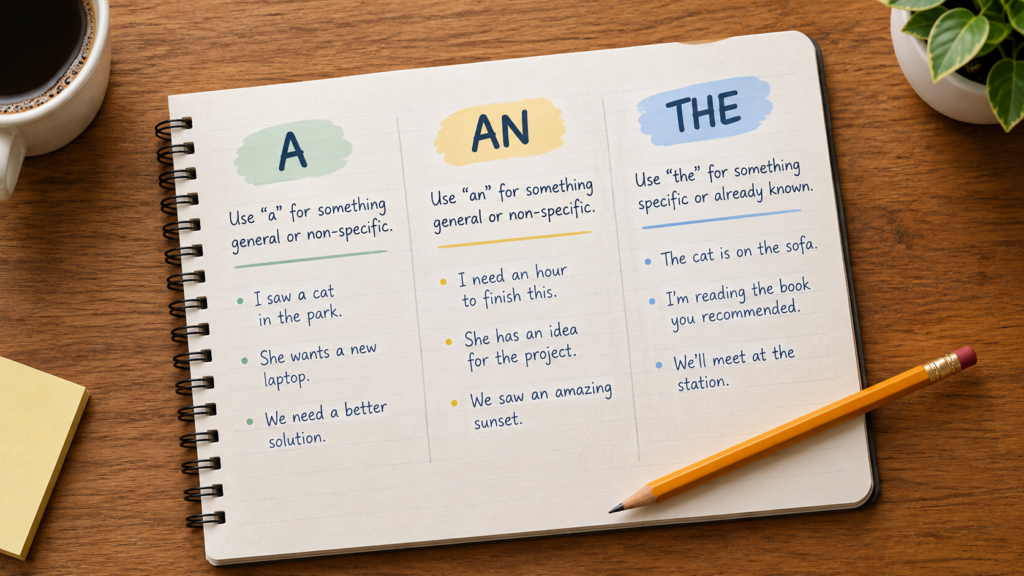
If you are learning English, you have probably asked yourself: when do I use a, when do I use an, and when do I use the? These three small words are called articles, and they appear in almost every English sentence. Getting them right is one of the first big steps toward sounding natural.
This guide explains the a an the rules in simple language, with examples you can use right away.
Quick Answer
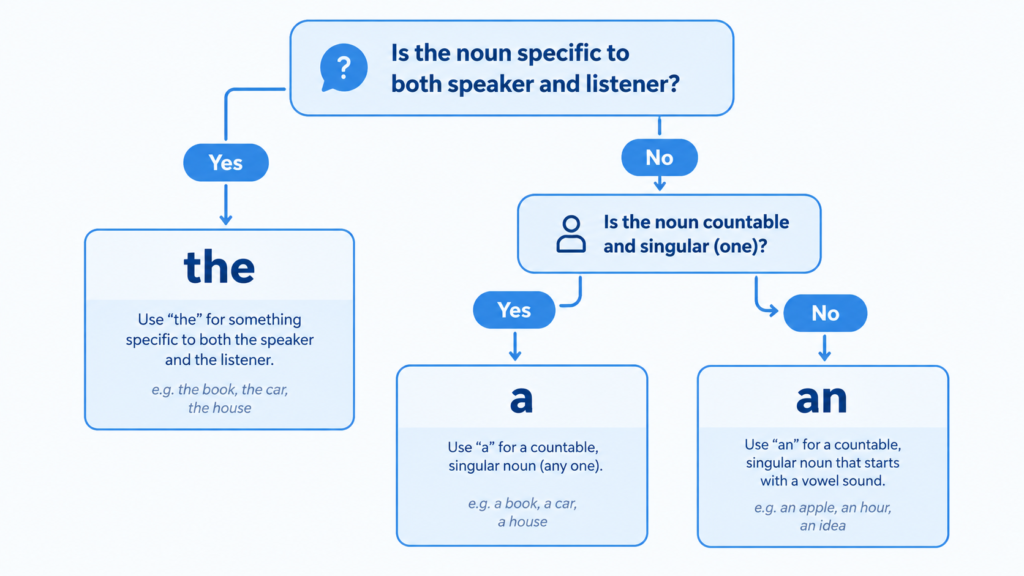
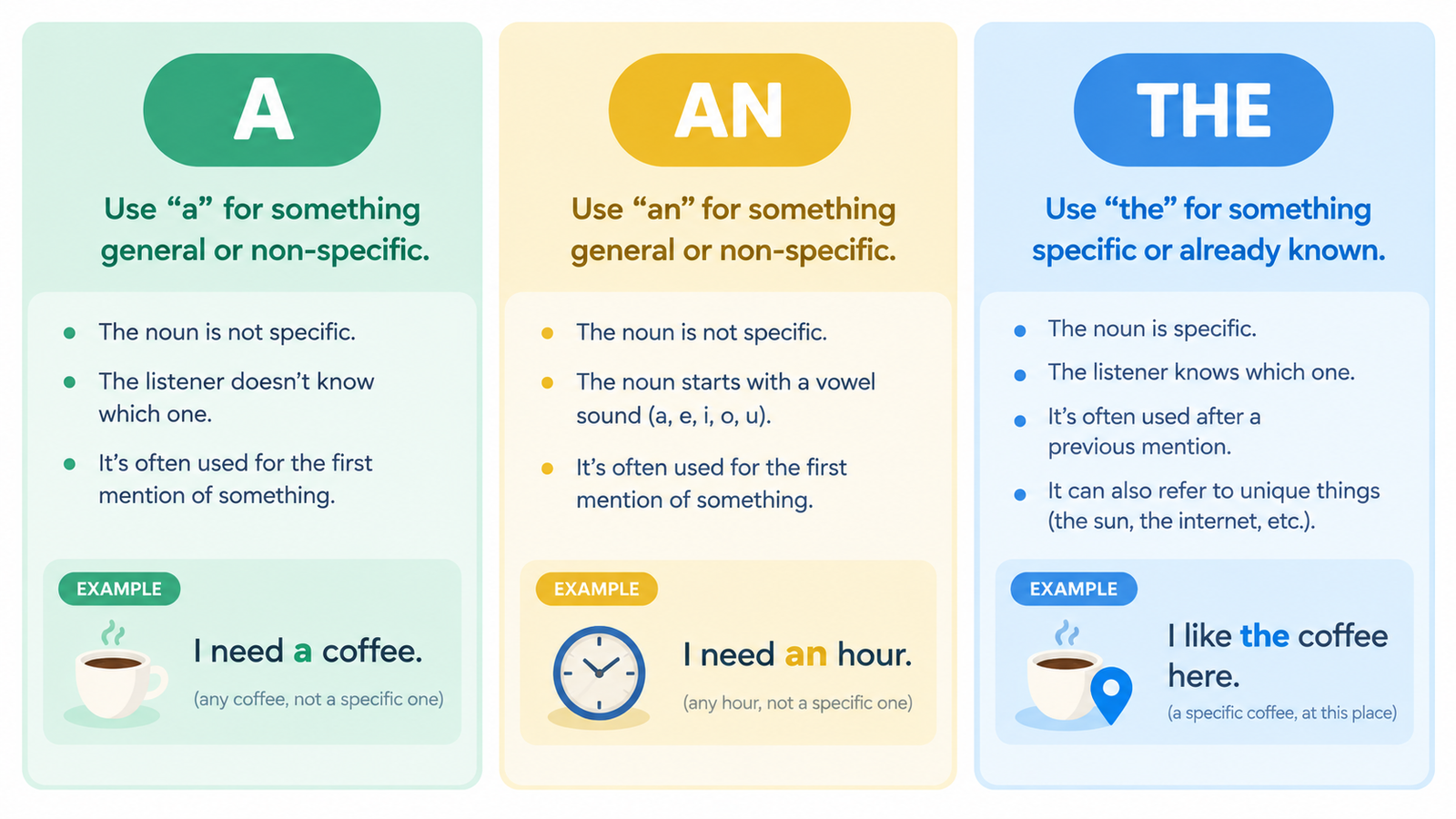
Use a before a consonant sound, use an before a vowel sound, and use the when both speaker and listener already know which thing you mean. Use a/an for something new or unspecific, one item from a group. Use the for something specific, already mentioned, or unique. If the noun is plural or uncountable and general, you often use no article at all.
What Are Articles?
Articles are small words that go before a noun. English has two kinds:
- Indefinite articles: a, an
- Definite article: the
They tell the listener how specific you are being. Say “a dog” and the listener does not know which dog. Say “the dog” and the listener knows exactly which one, maybe because you already mentioned it, or because there is only one in that situation.
A or An: It’s About Sound, Not Spelling
Many beginners think a goes before consonants and an goes before vowels. That is close, but not exactly right. The real rule is about the sound, not the letter.
- Use a before a consonant sound: a book, a car, a university
- Use an before a vowel sound: an apple, an hour, an umbrella
Notice a university. The word starts with the letter “u”, but it sounds like “yoo”, which is a consonant sound. That is why we say “a university”, not “an university”.
Now look at an hour. The “h” is silent, so the word starts with a vowel sound, “our”. That is why we say “an hour”, not “a hour”.
Examples:
| Sentence | Why |
|---|---|
| I have a cat. | “cat” starts with a consonant sound |
| She bought an orange. | “orange” starts with a vowel sound |
| He is a teacher. | “teacher” starts with a consonant sound |
| We waited an hour. | “hour” starts with a vowel sound (silent h) |
| They live in a house. | “house” starts with a consonant sound |
When to Use The
Use the when you and the listener both know which specific thing you mean. This happens in a few common situations:
- You already mentioned it. “I saw a dog. The dog was brown.” The first time, the dog is new information, so you use “a”. The second time, the listener knows which dog, so you use “the”.
- There is only one of it. The sun, the moon, the internet.
- It is clear from the situation. “Close the door, please.” (There is one door in the room, and both people know which one.)
- Superlatives and ranking words. The best restaurant in town, the first day of school.
Examples:
- I bought a laptop. The laptop is very fast.
- Can you turn off the light?
- She is the best student in the class.
When to Use No Article at All
This part surprises many learners. Sometimes English uses no article. This usually happens with:
- Plural or uncountable nouns used in a general sense: I like dogs. She drinks coffee every morning.
- Names of people, countries, and languages: Maria speaks Portuguese. He lives in Brazil.
- Common fixed expressions: go to bed, go to school, go home, at work
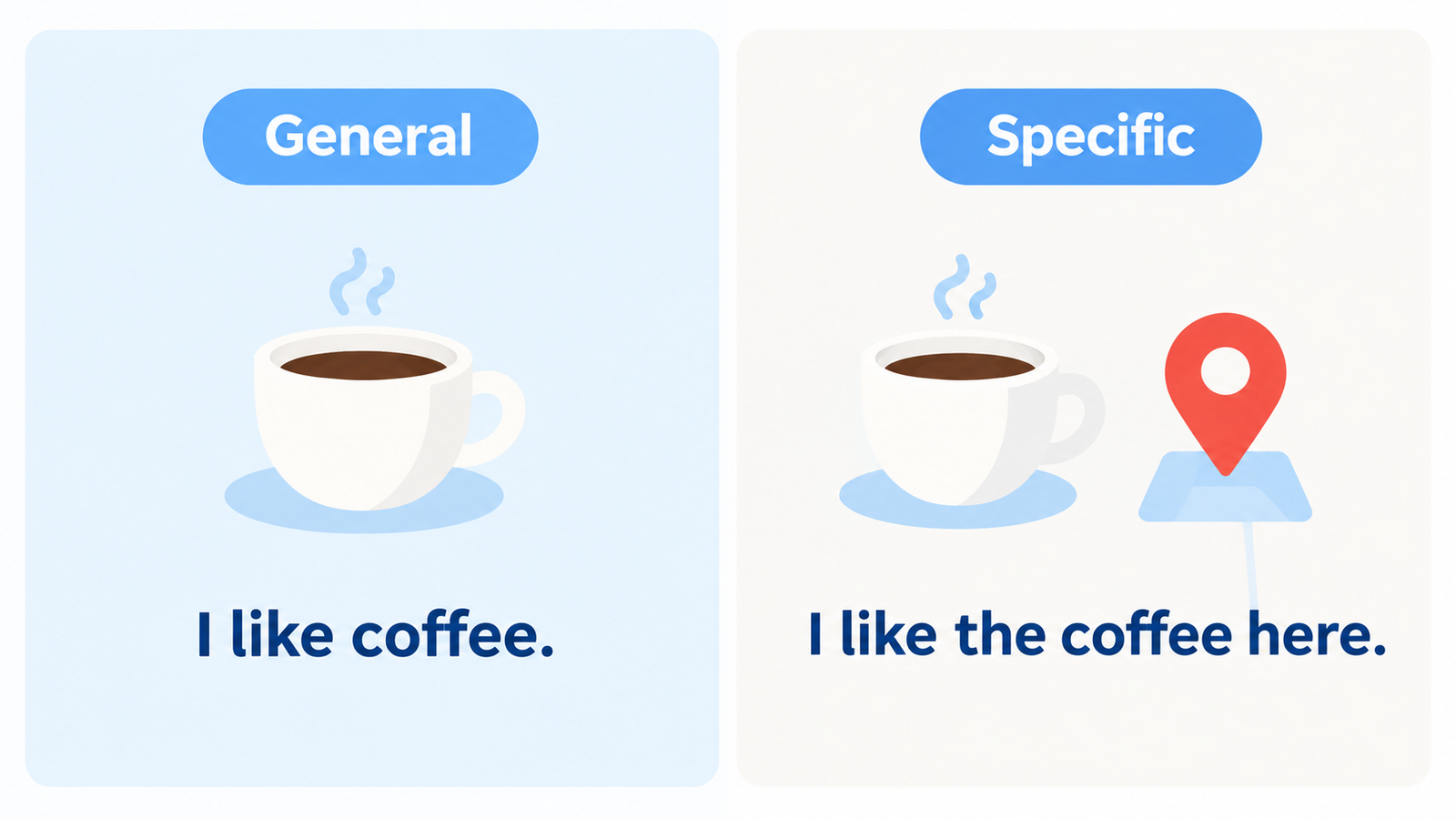
Compare these two sentences:
- “I like coffee.” (general statement about coffee in general, no article)
- “I like the coffee here.” (specific coffee, from this specific place, so we use “the”)
A/An vs The: The Key Differences
| Aspect | A / An (indefinite) | The (definite) |
|---|---|---|
| What it means | One item from a group, not specific | A specific, known item |
| First mention | Yes, usually used the first time | No, usually used after the first mention |
| Countable nouns only? | Yes, always singular countable nouns | No, works with singular, plural, and uncountable nouns |
| Example | I need a pen. | Where is the pen I gave you? |
There is no single “winner” between these two. The right choice depends entirely on whether the listener already knows which thing you mean.
Common Mistakes (and How to Fix Them)
1. Using “an” based on spelling, not sound
- Mistake: an university
- Why it’s wrong: “university” sounds like it starts with “y”, a consonant sound
- Fix: a university
2. Forgetting the article with singular countable nouns
- Mistake: I have cat.
- Why it’s wrong: singular countable nouns almost always need an article
- Fix: I have a cat.
3. Using “the” the first time you mention something
- Mistake: I saw the movie yesterday and it was great. (when the listener has no idea which movie)
- Why it’s wrong: “the” signals the listener already knows what you mean
- Fix: I saw a movie yesterday and it was great.
4. Adding an article before an uncountable noun used generally
- Mistake: I need an advice.
- Why it’s wrong: “advice” is uncountable, so it never takes “a” or “an”
- Fix: I need advice. or I need a piece of advice.
5. Using “the” with most country names
- Mistake: I visited the Brazil last year.
- Why it’s wrong: most country names take no article
- Fix: I visited Brazil last year.
Practice Tip
A simple way to check your instinct: read your sentence out loud. If the noun feels new or unspecific to the listener, try “a” or “an”. If it feels already known or unique, try “the”. If it is general and plural or uncountable, try no article at all. This will not cover every exception, but it solves the majority of everyday sentences.
FAQ
Do I always need an article before a noun in English?
No. Plural and uncountable nouns used in a general sense usually have no article, for example “I like music.”
Is “an historic” correct or “a historic”?
Both appear in real usage. “A historic” is more common today because most speakers pronounce the “h”. “An historic” is older and still used in some formal writing.
Why do we say “the United States” but not “the Brazil”?
Country names that describe a group of states, a union, or include words like “kingdom” or “republic” usually take “the”: the United States, the United Kingdom. Most single-name countries do not: Brazil, Portugal, Japan.
Can “the” ever mean “one of many” instead of “specific”?
Yes, in general statements about a category, such as “The smartphone changed how we communicate,” “the” refers to the category as a whole, not one specific phone.
Is there a shortcut to memorize all article rules?
Not a perfect one, but focusing on sound (for a/an) and on “does the listener already know this” (for the) covers most real conversations.
External References
- Cambridge Dictionary, “A/an and the” (English Grammar Today), https://dictionary.cambridge.org/grammar/british-grammar/a-an-and-the
- British Council LearnEnglish, “Articles: ‘a’, ‘an’, ‘the'”, https://learnenglish.britishcouncil.org/free-resources/grammar/a1-a2-grammar/articles-a-an-the
- British Council LearnEnglish, “Articles: ‘the’ or no article”, https://learnenglish.britishcouncil.org/basic-grammar/articles-2
- Grammarly, “What Are Articles in English Grammar?”, https://www.grammarly.com/blog/parts-of-speech/articles/