

If you write code for a living, you already know this problem. You spend three days fixing a database bottleneck that nobody will ever see, and when you try to explain it in a meeting, you get blank stares. Learning how to explain technical work to non-technical stakeholders is not a soft skill you can skip. It is part of the job, and it decides whether your best engineering work gets support or gets ignored.
I lead a small engineering team at a fintech company that builds payroll loan and insurance products. Every sprint, I talk to product managers, compliance officers, and business owners who have no idea what a message queue is and don’t need to know. What they need is to trust that my team is solving the right problems. This article shows the framework I actually use, with real examples from production work.
Quick answer: To explain technical work to non-technical stakeholders, connect every technical decision to a business outcome (money, risk, speed, or trust), use one simple analogy instead of jargon, show impact with numbers the listener already understands, and skip implementation details unless someone asks for them directly.
Why This Skill Matters More Than You Think
Developers often think communication is a “nice to have” compared to writing good code. In practice, it decides how much freedom you get to do good engineering work.
Here is what happens when developers cannot communicate value clearly:
- Refactoring work gets cut from the roadmap because it “doesn’t add value”
- Security and observability investments get postponed until something breaks
- Product managers make promises to clients based on wrong assumptions about effort
- Senior engineers get labeled as “hard to work with” even when they are technically right
None of these problems come from bad engineering. They come from a communication gap. The stakeholder is not against good engineering. They just cannot evaluate something they cannot understand.
The Core Problem: You Think in Systems, They Think in Outcomes
When a developer explains a decision, the explanation often follows the technical logic: first this component, then that dependency, then this edge case. This makes sense inside your head, but it is the wrong entry point for someone outside engineering.
Non-technical stakeholders think in outcomes. They care about:
- Will this cost more money or save money
- Will this make the product faster or slower for the user
- Will this reduce risk or increase risk
- Will this happen on time
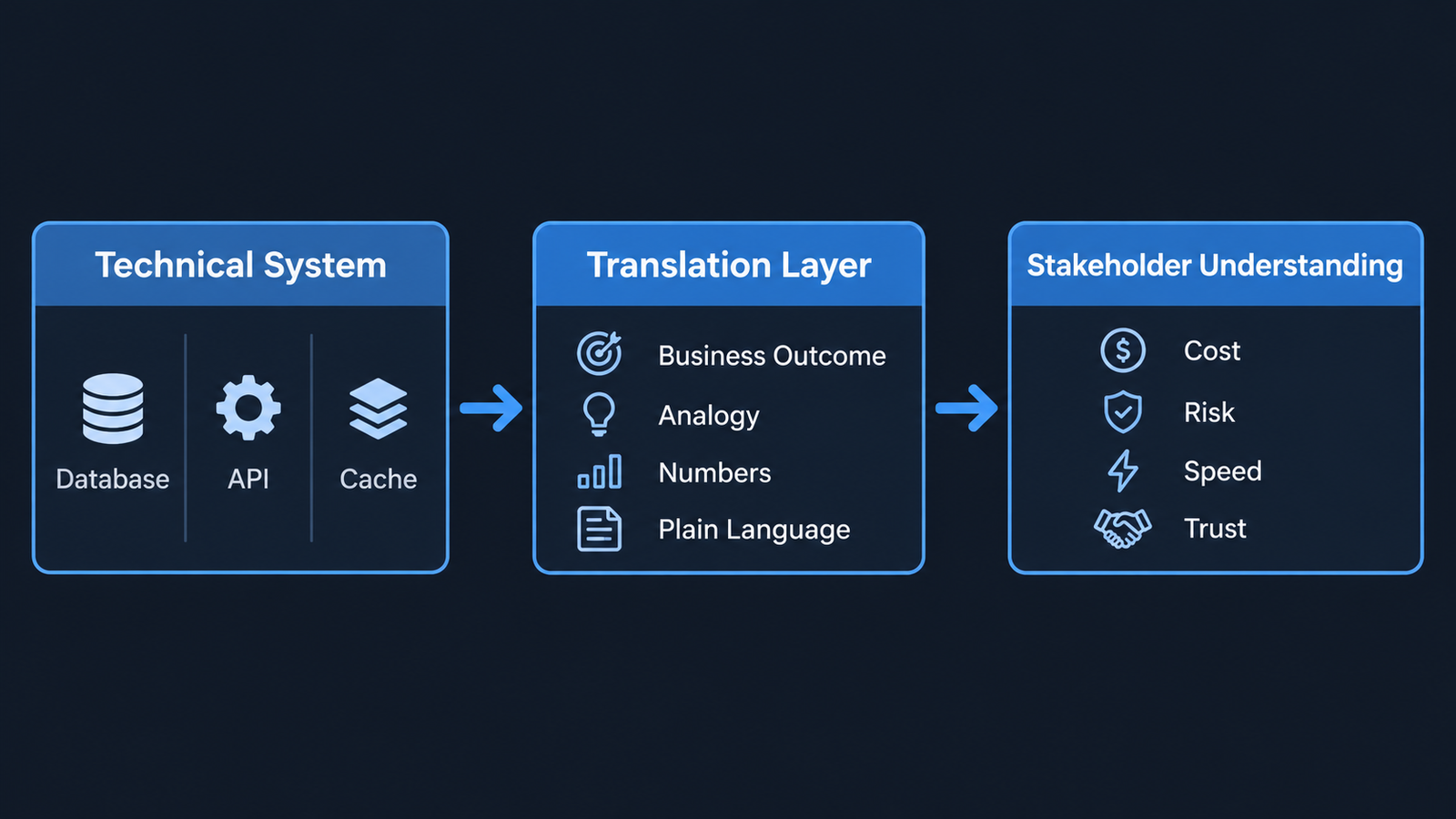
Your job is not to make them understand your system. Your job is to connect your system to one of these four things. Everything else is optional detail.
A Framework for Translating Technical Value
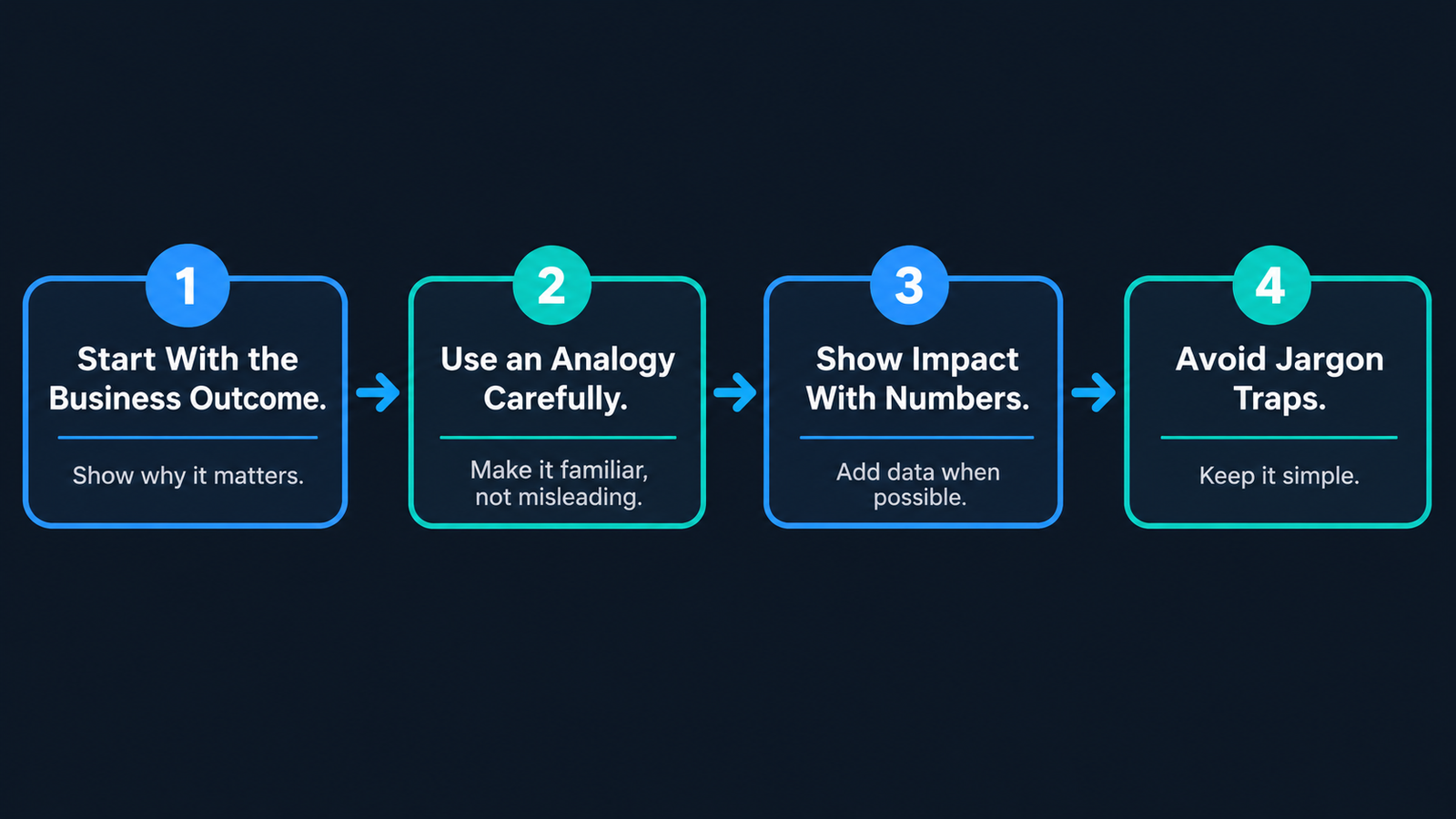
I use a simple four-step structure for any technical explanation, whether it is a Slack message, a sprint review, or a five-minute hallway conversation.
Step 1: Start With the Business Outcome
Before you say anything technical, say what changes for the business or the user. This is the headline. Everything technical comes after, only if needed.
Weak: “We are migrating from a monolith to microservices.”
Better: “This change will let us release new features without breaking the whole payment system, which means fewer production incidents and faster delivery.”
Step 2: Use Analogies Carefully
Analogies are useful, but only when they are accurate enough not to create wrong expectations. A bad analogy can hurt you more than no analogy at all.
For example, comparing technical debt to a loan works well because the audience already understands interest and repayment. Comparing a distributed system to “a team of chefs in a kitchen” can work for explaining parallel processing, but be careful: don’t stretch it past the point where it stays true.
Good rule: use one analogy per idea, and drop it as soon as it stops matching reality.
Step 3: Show Impact With Numbers They Understand
Developers like precise technical numbers: milliseconds, memory usage, query counts. Business stakeholders respond better to numbers tied to outcomes they already track.
| Technical number | Business-friendly version |
|---|---|
| “P95 latency dropped from 800ms to 120ms” | “The loan simulator now responds almost instantly instead of making users wait” |
| “We reduced database queries per request from 40 to 6” | “The page that used to slow down during peak hours now handles the same load without slowing down” |
| “We added retry logic with exponential backoff” | “If our payment provider has a short outage, the system recovers on its own instead of losing transactions” |
Notice that the right column still tells the truth. It just removes the parts the listener cannot act on.
Step 4: Avoid Jargon Traps
Some words feel neutral to developers but sound alarming or confusing to non-technical people. A few examples from my own experience:
- “Legacy system” sounds like “old and broken” to a business person, even when the system works fine and is just older
- “Technical debt” sounds abstract until you explain it as “shortcuts we took earlier that now cost extra time to work around”
- “Refactor” sounds like “rewrite everything” to someone outside engineering, when it usually means something much smaller
You don’t need to remove all technical words. You need to explain the ones that carry a different meaning outside engineering.
Real Examples From Production Work
Explaining Technical Debt
When I ask for time to pay down technical debt in a payroll loan platform, I don’t start with the code. I start with this: “Every new feature in this module now takes about 30% longer to build and test because of shortcuts we took under a tight deadline last year. If we spend one sprint fixing the core of it, future features in this area will ship faster, and we will have fewer production bugs.”
Explaining a Database Migration
Instead of describing indexes and query plans, I explain what the business will notice: “Right now, when a customer submits a batch of loan proposals, the screen can take up to 10 seconds to respond during busy hours. This migration removes that delay almost completely, without changing anything visible in the interface.”
Explaining Why an API Needs Rate Limiting
“We are adding a limit on how many requests a single partner can send per minute. Without it, one partner having a bug on their side could slow down the system for every other partner. This protects our uptime for everyone.”
Explaining Observability Investment
“Right now, when something goes wrong in production, it can take our team 30 to 40 minutes just to find out where the problem is. With better monitoring and dashboards, we expect to cut that down to a few minutes, which means shorter outages and less impact on customers.”
Comparison: Technical Framing vs Business Framing
| Situation | Technical framing (developers) | Business framing (stakeholders) |
|---|---|---|
| Code quality issue | “The code has high coupling between modules” | “Changes in one part of the system often break another part by accident” |
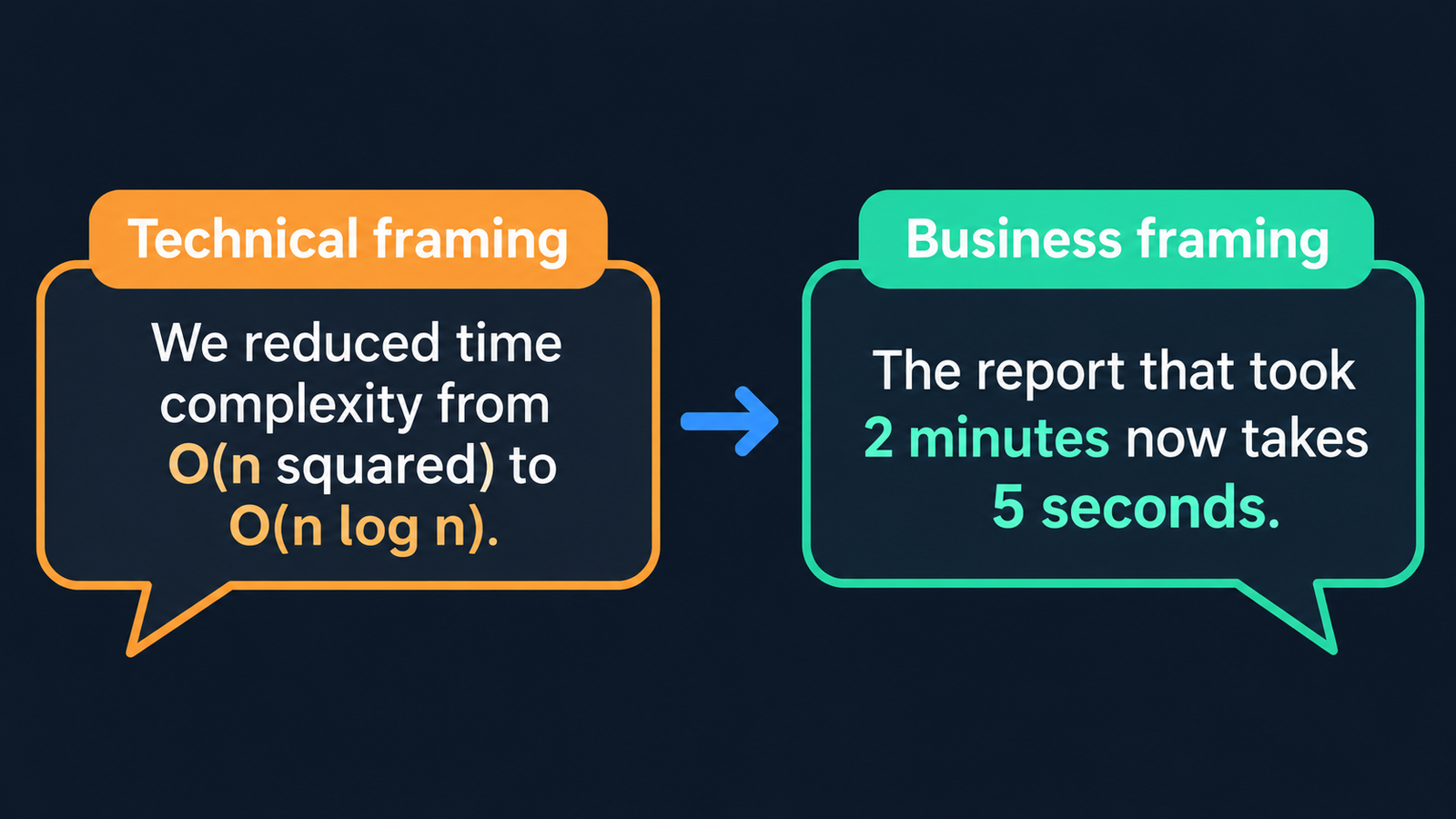
| Performance work | “We reduced time complexity from O(n²) to O(n log n)” | “The report that used to take 2 minutes to generate now takes 5 seconds” |
| Infrastructure change | “We moved from a single VM to a Kubernetes cluster with autoscaling” | “The system can now automatically handle traffic spikes without going down” |
| Security fix | “We patched a SQL injection vulnerability” | “We closed a gap that could have let someone access data they shouldn’t see” |
The technical framing is not wrong. It is just aimed at the wrong audience in most meetings. Save it for code review, architecture discussions, and conversations with other engineers.
A Simple Template You Can Reuse
When I need to explain a technical decision in writing, for example in a sprint report or a Slack update, I follow this short structure:
1. What changed (one sentence, no jargon)
2. Why it matters (money, risk, speed, or trust)
3. What the user or business will notice (or won't notice, and why that's good)
4. What happens next (optional, only if there is a follow-up action needed)
This fits in four sentences most of the time. If a stakeholder wants more detail, they will ask, and that is your cue to go one level deeper, not three levels deeper at once.
When NOT to Simplify
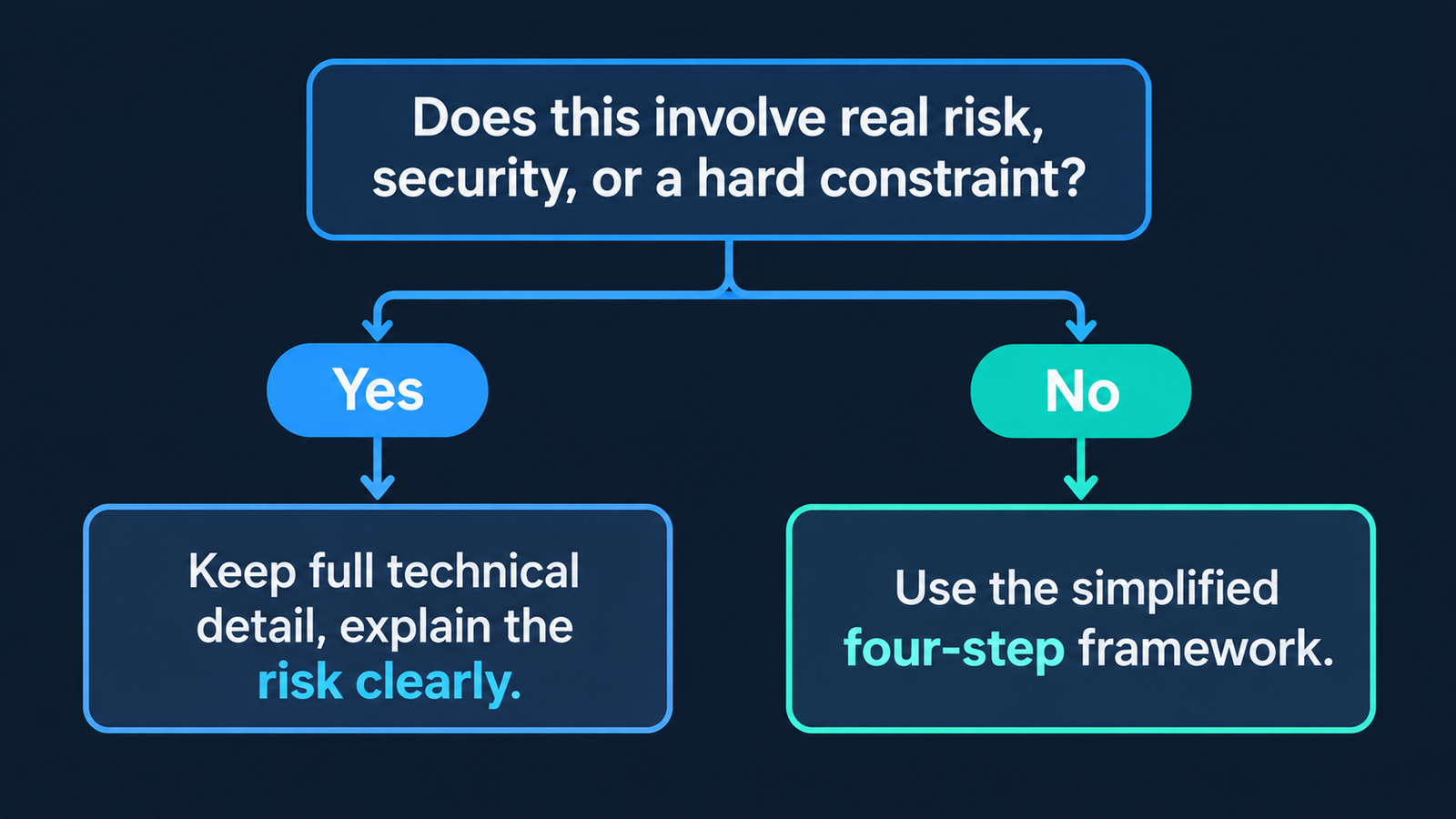
Simplifying does not mean hiding real risk or making things sound easier than they are. There are situations where you should keep full technical honesty, even if it takes longer to explain:
- When there is real risk of data loss or a security issue, explain the risk clearly, even with some technical detail, so the decision-maker understands the stakes
- When you are asked directly for a technical explanation by someone who wants it, for example another engineer or a technical product manager
- When a deadline is unrealistic because of a real technical constraint, don’t soften it into vague language just to avoid conflict
Being clear is not the same as being vague. The goal is to remove noise, not to remove important information.
Common Mistakes Developers Make
1. Leading with the solution instead of the problem
Developers often start with “we implemented Redis caching” before explaining what problem it solves. Stakeholders lose interest before they understand why it matters. Start with the problem, then the outcome, and only then the solution if it’s relevant.
2. Explaining everything at the same level of detail
Not every part of a technical decision deserves the same amount of explanation. Focus on the one or two points that actually change the business outcome, and summarize the rest in one line.
3. Assuming silence means understanding
When stakeholders go quiet in a technical explanation, it usually means they are lost, not that everything is clear. Ask a direct question like “does this match what you expected?” instead of assuming agreement.
4. Using the same explanation for every audience
A compliance officer, a product manager, and a CEO care about different outcomes. The same technical work might need three different framings depending on who is in the room.
5. Treating “non-technical” as “less intelligent”
This is a common trap, and it shows in tone. Non-technical stakeholders are experts in their own area. The goal is translation, not simplification for the sake of talking down to someone.
6. Skipping the “why” and only giving the “what”
Saying “we’re adding rate limiting” without saying why leaves room for the stakeholder to assume it’s just extra engineering complexity. Always connect the what to the why.
7. Avoiding hard conversations by hiding behind jargon
Sometimes developers use complex language on purpose, to avoid a difficult conversation about a delay or a mistake. This damages trust faster than the mistake itself would.
FAQ
How do I explain technical debt to a non-technical manager?
Compare it to a financial loan: shortcuts taken now create ongoing extra cost later, similar to interest. Then give one concrete example of a task that takes longer today because of it.
What if a stakeholder asks a technical question I can’t simplify?
Answer honestly and offer to go deeper. Say something like “that part is technical, would you like the short version or the full explanation?” Let them choose the level of detail.
How much detail should I include in a sprint report for business stakeholders?
Use the four-part template from this article: what changed, why it matters, what the user notices, and what happens next. Keep it to a few sentences per item.
Is it wrong to use technical terms with non-technical stakeholders?
No, but define them the first time you use them, in the same sentence or the one right after. Over time, stakeholders learn the terms that matter to your product.
How do I convince stakeholders to invest in things like observability or refactoring?
Tie the investment directly to time or money already being lost, using a real example from your own system whenever possible. Abstract arguments about “code quality” rarely win budget on their own.
External References
- Google, Site Reliability Engineering (chapter on communicating business and production priorities): https://sre.google/sre-book/table-of-contents/
- Atlassian, “What Is Technical Debt”: https://www.atlassian.com/agile/software-development/technical-debt
- Manifesto for Agile Software Development: https://agilemanifesto.org/
- Team Topologies, on team interaction and communication patterns: https://teamtopologies.com/
- Grafana Labs, observability documentation: https://grafana.com/docs/